- Anubhav Sarker
- Published: 09/22/2026
- Last Updated: 13/08/2026
Why the lead qualification process matters
Lead qualification is how you stop doing that. It's the process of deciding which leads are worth pursuing, based on whether they fit your business, have a problem you solve, and can realistically buy from you. When done well, it tells you who to call first, who to keep warm, and who to let go of politely.
That's the short answer. The rest of this guide covers the longer one: what counts as a qualified lead, who should do the qualifying, when it happens, which criteria and frameworks to use, and how to run the whole thing when your entire sales department is you.
What counts as a qualified lead
A lead is anyone who has shown interest and left a way to reach them. A form fill, a call, a business card from a trade show. That's a low bar, and it should be. At this stage, a lead could be your next biggest customer or a student writing a paper.
A qualified lead has cleared a higher bar. You've confirmed, through data or a conversation, that they match the kind of customer you serve, they have a problem your product or service addresses, and they have the money and the standing to make a purchase. Miss any one of those, and you're nurturing a maybe, which is fine, as long as you know that's what it is.
Larger companies slice this into stages, and the labels show up everywhere, so they're worth knowing:
- A marketing qualified lead (MQL) has engaged enough with your marketing, say downloads plus repeat visits to the pricing page, that marketing considers them ready for sales attention.
- A sales-accepted lead (SAL) is an MQL that a salesperson has reviewed and agreed is worth a call. Some companies skip this label entirely.
- A sales-qualified lead (SQL) has been vetted in conversation: the need is real, the money exists, and there's a path to a decision. These are added to the pipeline as opportunities.
- A product qualified lead (PQL) has used a free trial or free plan and met usage milestones, indicating they're ready to pay.
If you're a team of four, you won't run four lead stages, and you shouldn't. But the underlying question those labels encode never changes: has anyone confirmed this person can and might buy? Until someone has, the lead isn't qualified, whatever your spreadsheet says.
Why lead qualification matters
Because your selling time is the scarcest thing you have, Salesforce's State of Sales research found that full-time sales reps spend about 28% of their week selling; the rest is spent on admin work and data entry. A small business owner has it worse, because sales is the hour found between actual jobs. Spend that hour on a bad-fit lead, and it's gone.
Speed makes the math harsher. In 2024, RevenueHero submitted demo requests to 1,000 B2B companies; 63.5% never responded at all, and the companies that did reply took about 29 hours on average. The silence is expensive. A 2011 Harvard Business Review study, "The Short Life of Online Sales Leads," found that firms reaching out within an hour of an inquiry were nearly seven times as likely to qualify the lead as those that waited even an hour longer; newer audits track how slow companies are, but that study remains the best evidence of what the delay costs. You can't be that fast for everyone, so qualification decides who gets your fastest hour.
There's a quieter benefit, too. Bad-fit customers don't stop costing you at the sale; they buy, then churn, demand refunds, and leave the reviews you'd rather not have. Qualification is as much about protecting the business you'll have next year as filling this month's pipeline. And when you track why leads pass or fail, you learn things: which ad channel sends tire kickers, which referral source sends buyers, which product page attracts the wrong industry. That feedback is worth more than most paid market research.
When does qualification happen in the sales process?
It's tempting to picture qualification as a gate a lead passes through once. In practice, it happens at three points, and the third one is the one people forget.
The first pass happens at capture, before any conversation. The form data, email domain, and company website indicate whether the lead is even in your market. A wedding photographer who serves one metro area can disqualify an inquiry from another country in ten seconds. This is where a qualifying question on your contact form ("What's your budget range?" or "How many locations do you run?") earns its keep.
The second pass is the first real conversation, often called a discovery call. This is where frameworks like BANT and CHAMP live, and where most of the questions later in this guide get asked. In a company with a sales team, this call sits between lead generation and the demo or proposal. In a small business, it's often the same call where you'd otherwise start pitching. Resist that. Ask first.
The third pass never really ends. Deals get disqualified late, and that's healthy. The budget gets cut, or the competitor's contract runs another 18 months. Requalifying as new information arrives is what keeps your pipeline honest, and your revenue forecast something better than a wish.
Who is responsible for qualifying leads?
In a company with a full sales organization, the answer has layers. Marketing makes the first pass, using engagement and company data to promote leads to MQL status. A sales development rep (SDR), whose whole job is outreach and first calls, makes contact and confirms the basics: the right kind of company, a real problem, someone worth a longer meeting. The SDR then books that meeting for an account executive (AE), the salesperson who owns the deal, and the AE requalifies during discovery before investing in demos and proposals. Marketing versus sales arguments usually stem from these teams defining "qualified" differently, which is why larger companies develop shared definitions and review them together.
In a small business, the org chart collapses into one chair. The founder is the marketer, the SDR, and the AE, sometimes before lunch. That's workable. What doesn't work is qualifying by mood, where a lead feels promising on a good day and gets ignored on a busy one. The fix costs nothing: write your criteria. Even three lines ("US-based, 10+ employees, willing to spend at least $200 a month") turn qualification from a vibe into a decision someone else could make the same way.
If there are two or more of you, agree on the handoff. What must be true before a lead moves from "new" to "worth a proposal"? Who checks? Where does the answer get recorded? Most dropped leads in small teams fall into exactly that gap. Effort was never the problem.
Lead qualification criteria: what to check
Almost every framework, whatever its acronym, is checking some mix of five things: fit, need, budget, authority, and timing.
Fit is whether they look like your customer at all. Industry, company size, location, business type. This is the cheapest criterion to check because most of it is visible before you ever talk, and it's the one worth turning into hard rules. If you only serve dental practices, a gym inquiry will fail on fit, no matter how enthusiastic the email sounds.
The question is whether they have a problem you can solve, specifically. "Interested in learning more" is not a need. "We're double-booking clients because our schedule lives in three places." The sharper the problem statement you can get from them, the more real the deal.
Budget is whether they can pay what you charge. For small businesses selling, the useful version of the question is rarely "what's your budget?" It's whether the smallest thing you'd sell them fits inside what the problem already costs them, in money or in wasted hours.
Authority is whether you're talking to someone who can say yes, or who can walk you to that person. Small business deals usually have short chains; the owner decides. But in family businesses and partnerships, the silent partner who kills deals at the last minute is a real character. Ask early who else weighs in.
Timing is whether anything makes this a now problem: a lease ending, a busy season approaching, a contract renewal, or a new hire starting. No trigger usually means no urgency, and no urgency means a long, drifting sales conversation.
Alongside what people tell you, watch what they do. Someone who returns to your pricing page twice, replies within the hour, and asks specific questions about implementation is behaving like a buyer. Someone who takes a week to answer and asks only for a discount is behaving like a browser. Behavior isn't proof, but it's evidence, and it's evidence they can't polish.
Lead qualification frameworks: BANT, CHAMP, MEDDIC, and the rest
Frameworks are memory aids. They exist so that nobody hangs up from a promising call having forgotten to ask who signs the check. Here are the ones you'll run into:
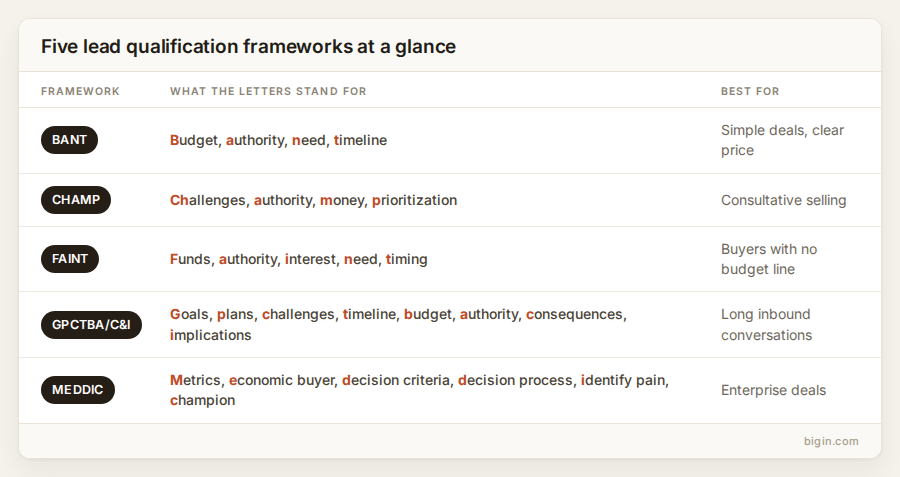
BANT emerged from IBM decades ago and survives because it's easy to remember and hard to skip past. Its weakness is opening with a budget, which can feel blunt when the prospect is still working out whether they have a problem. CHAMP fixes that by starting with the challenge and letting the money conversation arrive once the cost of the problem is on the table.
FAINT, developed by the RAIN Group, deserves more attention from small business sellers than it gets. Its premise is that plenty of real buyers have funds without having a budget, because nobody at a 12-person company writes a line item for software they haven't discovered yet. If your customers are small businesses, too, FAINT's assumptions better reflect their reality than BANT's.
GPCTBA/C&I is HubSpot's framework, and it's thorough enough to serve as a full discovery methodology. MEDDIC is built for six-figure enterprise deals with five-person buying committees, security reviews, and procurement teams. It's excellent at what it does. What it does is not small business sales. My honest advice: if your typical deal closes in under a month with one or two decision-makers, pick BANT or CHAMP, borrow FAINT's view of budget, and spend the time you save talking to customers.
One warning that applies to all of them: a framework is a checklist for listening, not a script for interrogating. Nobody wants to be BANTed. Spread the questions across a natural conversation and let their answers, not your acronym, set the order.
How to qualify leads in six steps
Here is the whole lead qualification process, sized for a small team.
- Study your last 20 or 30 customers
Not your dream customers, your real ones. Which industries, sizes, and situations show up again and again among the ones who paid on time and sent more work your way? Do the same for the deals that went bad. The differences between those two lists are your criteria, and they're worth more than any template.
- Write down the criteria, including the hard disqualifiers
Aim for a handful of must-haves (region, business type, minimum size or spend) and two or three automatic nos (industries you can't serve, budgets below your floor, requirements you don't offer). If a new hire couldn't apply your rules after a five-minute explanation, they're too complicated.
- Capture the same information for every lead
A short contact form with one qualifying question beats a long form nobody finishes. Whatever arrives by phone or referral, record it in the same fields, in the same place. Inconsistent data is how good leads end up judged on half the picture.
- Have the conversation
Use the questions in the next section, spaced through a real discussion. Your job on this call is to disqualify, which sounds backward until you try it: when you're checking for reasons to say no, you listen harder, pitch less, and come across as someone worth buying from.
- Decide, and log the reason
Every lead exits this step in one of three states: pursue now, nurture for later, or disqualify. "Nurture" means a concrete follow-up date, not a graveyard. And write down why you made the decisions you did; those notes are the raw material for step six.
- Review the rules every quarter
Check your disqualified list for people who later bought elsewhere, and your closed deals for ones that passed but shouldn't have. Criteria written once and never revisited quietly go stale as your product, prices, and market move.
Lead qualification questions to ask
You won't ask all of these, and you shouldn't ask any of them in a row. Pick what fits the conversation.
About the problem:
- What's going on that made you reach out now?
- How are you handling this today, and what's not working about it?
- What happens if you leave things exactly as they are?
About money:
- Have you set money aside for this, or would it come out of general spending?
- What is the current way of doing things costing you, in fees or in hours?
- Is there a price that would make this an easy no?
About the decision:
- Who else would weigh in before you signed off on something like this?
- What would you need to see from us to feel confident going ahead?
About timing:
- When do you want this up and running?
- Is there a date behind that, like a season, a contract ending, or a launch?
- What else is competing for your attention right now?
The last one sounds like small talk. It isn't. A prospect who is also mid-move, mid-hire, and mid-audit may love your product and still not buy this quarter, and it's better to learn that in minute ten than in week six.
Lead qualification vs. lead scoring
The two get used interchangeably and shouldn't be. Qualification is a judgment: yes, no, or not yet. Lead scoring assigns points, usually for fit (right industry, right size, right role) and behavior (visited pricing, opened emails, booked a call), so that a large volume of leads can be ranked and routed automatically. Scoring says who to work first; qualification says whether to work them at all.
For most small businesses, formal scoring is a solution to a volume problem you don't have. RevenueHero, whose 2025 benchmark analyzed over a million inbound form submissions, found that even most mid-market companies skip numeric scoring in favor of simple pass/fail rules, and suggests binary rules serve you better below roughly 500 inbound leads a month. If you're getting 30 leads a month, a points model is a spreadsheet hobby. Two or three hard rules plus a real conversation will beat it every time.
Disqualify without burning the bridge.
Disqualifying leads feels like losing, especially when the pipeline is thin. It's the opposite. Every no protects the hours that turn a real prospect into a customer, and it's the entire point of the exercise. Teams that never disqualify don't have bigger pipelines; they have foggier ones.
A no today also isn't a no forever. A lead that fails on timing or budget but fits everything else belongs on a nurture list with an occasional useful email and a follow-up date, because the lease eventually ends and the budget eventually appears. A lead that fails on fit deserves a straight answer and, when you can manage it, a pointer to someone who suits them better. Small businesses live on reputation, and "they told me the truth and sent me somewhere better" is the kind of story that comes back as referrals.
Log the reason every time you disqualify. Six months of reasons will tell you which marketing channel to fix, faster than any report.
Mistakes that undo the whole thing
Running qualification as an interrogation
Ten rapid-fire questions before you've offered anything of use makes prospects defensive, and defensive people give bad data. Trade information: give a little insight, ask a question, repeat.
Qualifying on gut feel
Instinct built on years of customer experience is real, but it doesn't scale beyond you, and it wobbles when you're tired or the month is slow. Written criteria keep the standard steady.
Never saying no.
If every lead stays "open," your pipeline number is fiction, and your follow-up energy is spread across people who will never buy.
Letting qualified leads rot
The 42-hour average response time in that HBR study wasn't caused by laziness; it was caused by no one reminding anyone. A follow-up that fires two days late is a deal handed to whoever answered first.
Setting the rules once and moving on.
The criteria that matched your business at launch won't match it after a price change, a new service line, or a shift in who's buying.
Where a CRM fits in
None of the above requires software. It requires writing the same things down about every lead, every time, and acting on them before the lead cools. At very low volume, a disciplined spreadsheet does that. The discipline, not the tool, is the ingredient.
The tool starts to matter when leads slip: the form fill nobody saw or the "call back in March" that never happened. A CRM gives qualification a home. Your criteria become required fields; your pipeline stages mirror the lead's status (new, qualifying, qualified, nurture); your web form feeds leads straight in with the qualifying question already answered; and automated reminders make sure "follow up Tuesday" survives contact with an ordinary Tuesday.
That's the job Bigin was built for. It's a pipeline-first CRM made for small businesses: web forms, multiple pipelines, simple automations, and email and phone in one place, without the setup project a full-scale CRM demands. There's a free plan for a single user, and paid plans start at $7 per user per month, billed annually, which is to say the cost of losing one warm lead a year covers it many times over. If you're currently qualifying leads in your head, it's a cheap way to stop.
FAQs about lead qualification
What are the main lead qualification criteria?
Five come up in nearly every framework: fit (do they match the customers you serve), need (do they have a problem you solve), budget (can they pay what you charge), authority (can they make or reach the buying decision), and timing (is anything making this urgent). Behavioral signals such as pricing page visits and fast replies round out the picture.
What is the difference between an MQL and an SQL?
An MQL (marketing qualified lead) has shown enough engagement with your marketing to warrant a sales conversation, but no one has verified them yet. An SQL (sales-qualified lead) has been confirmed in conversation to have a real need, funds, and a path to a decision. MQL is an educated guess; SQL is a checked fact.
Who should qualify as leads in a small business?
Whoever talks to prospects, which is often the owner. The role matters less than the method: written criteria, the same questions for every lead, and a recorded decision with a reason. Once two or more people handle leads, they agree on what "qualified" means and where the handoff happens.
When should you disqualify a lead?
Immediately on hard failures such as wrong region, wrong business type, or a budget below your floor. After a conversation, when there's no problem they can put into words, no path to a decision maker, or no timeline, and no trigger on the horizon. Leads that fail only on timing or budget go to a nurture list with a follow-up date rather than the bin.
Is BANT still relevant?
Yes, with adjustments. Budget-first questioning can land badly early in a conversation, and modern buyers often have funds without a formal budget, which is why variants like CHAMP and FAINT reorder or reframe it. For a small business with short sales cycles, BANT's four checks remain a perfectly good minimum, whatever order you ask them in.
How is lead qualification different from lead generation?
Generation fills the top of the funnel: ads, content, referrals, and forms that produce leads. Qualification sorts what generation brings in, so your selling time goes to the leads most likely to become customers. One without the other is either an empty pipeline or a busy, unprofitable one.
--
Edited by Anubhav Sarker | Images on this article are AI generated. Please verify thoroughly before using